Key takeaways
- Dental X-rays use a very low radiation dose, and modern digital sensors lower it further still.
- Dentists follow the as-low-as-reasonably-achievable principle: X-rays only when they will change your care, with shielding where appropriate.
- In pregnancy, routine X-rays are usually postponed as a precaution; urgent ones can be taken safely with shielding — always tell your dentist.
- There is no fixed schedule — how often you need X-rays depends on your age and your decay and gum-disease risk.
"Do I really need an X-ray?" and "Is it safe?" are among the most common questions dentists hear. It is a fair concern, and the honest answer is reassuring: dental X-rays use a very small dose of radiation and are taken with real safety steps, only when they will genuinely help. Here is how safe they are, what changes during pregnancy and for children, and why they remain such a useful tool.
Quick answer: Dental X-rays carry a very low radiation dose, lowered further by digital technology, and are taken only when they will change your care, following the lowest-reasonable-dose principle. In pregnancy they are usually postponed as a precaution unless urgent; for children they are used carefully when needed. How often you need them depends on your risk, not a fixed timetable.
Why dentists use X-rays at all
A lot of dental trouble hides where the eye cannot reach: decay starting between teeth, infection at the root tip, bone loss from gum disease, or an adult tooth developing under the gum. X-rays reveal these early, when they are simpler to treat, and prevent surprises. Different images answer different questions, our guides to the OPG panoramic X-ray, the RVG digital X-ray and the 3D CBCT scan explain what each one shows.
How small is the dose?
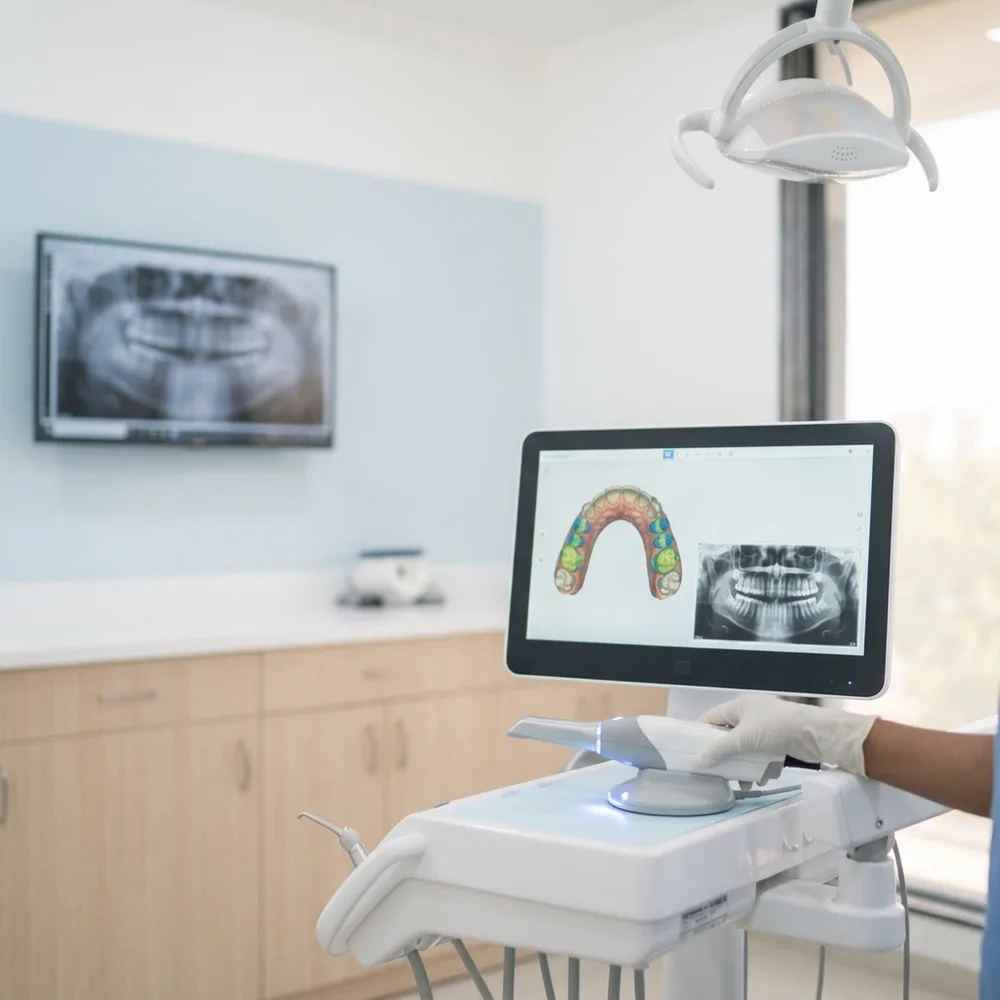
The radiation from a routine dental X-ray is very low, much smaller than most medical scans and on a par with the natural background radiation we all absorb from the environment over a short everyday period. Digital sensors, which our clinic uses, reduce the dose further compared with old-fashioned film, and give an instant image. Put simply, an occasional dental X-ray is a small, well-justified exposure for the diagnostic value it provides.
The safety steps behind every X-ray
Dentistry follows the principle of keeping radiation as low as reasonably achievable. In practice that means only taking an X-ray when it will actually influence your diagnosis or treatment, choosing the right type for the question, using modern low-dose digital equipment, and applying protection where appropriate. You should never feel an X-ray is routine for its own sake, there should be a reason, and a good dentist is happy to explain it.
Pregnancy and children
During pregnancy, routine dental X-rays are generally postponed as a sensible precaution, though an urgent one, say for a painful infection, can be taken safely with shielding and minimal exposure; the key is to tell your dentist if you are or might be pregnant, which our guide to dental care during pregnancy covers more fully. For children, X-rays are used when genuinely needed, to check for hidden decay or to follow developing adult teeth, always at the lowest suitable dose, with the benefit of catching problems early weighed carefully against keeping exposure minimal.
How often do you need them?
There is no one-size-fits-all schedule. How often you need X-rays depends on your age and your individual risk of decay and gum disease: a person with healthy teeth and low risk needs them far less often than someone with active or recurring problems. The decision is based on clinical need, not a fixed calendar. At our clinic in Viman Nagar, Pune, digital imaging is part of everyday diagnostic care, used only when it helps.
Sources & further reading
American Dental Association (MouthHealthy) · NHS, Dental Health · FDI World Dental Federation · Indian Dental Association
About images: Images labelled 'AI-generated image' are illustrations created with AI tools. They do not show Prudent Dental Clinic, our team or our patients. Real photos of the clinic are captioned as such.
Dental X-ray safety: your questions answered
- What is an OPG X-ray? Panoramic dental X-ray explained
- What is RVG? Digital dental X-rays explained
- CBCT scans: how 3D imaging makes dental treatment safer
- Digital x rays
- Ceramic vs metal braces: which should you choose?
- Retainers after braces: types, care and how long
- How to read your dental treatment plan and estimate
- Zirconia vs porcelain veneers: how to choose
- Adult braces: is it ever too late?
Questions about a dental X-ray you have been advised? We are glad to explain. Call +91 70287 22200.
Call +91 70287 22200 · Open 7 days, 9 AM–9 PM (5 PM Sun)