

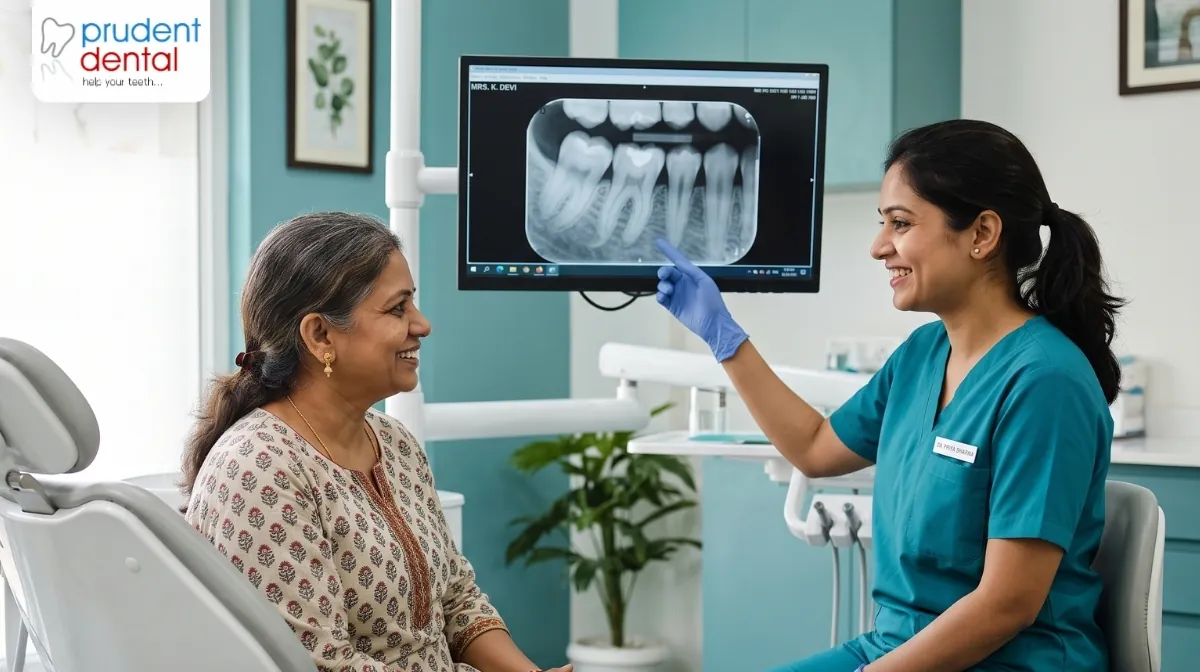
 AI-generated image
Key takeaways
- OPG stands for orthopantomogram: a panoramic X-ray that shows all your teeth, both jaws and the surrounding structures in one image.
- It is commonly used to assess wisdom teeth, plan braces, take a first look before implants, and check jaw problems or injuries.
- An OPG gives the big picture; an RVG gives fine detail of one or two teeth; a CBCT gives a 3D view when depth matters.
- The scan is quick, painless and uses a low dose of radiation; tell the team if you are or might be pregnant.
If your dentist has asked for an OPG, you will usually stand in a machine for a few moments while it moves around your head. The result is one wide image of your whole mouth. Here is what that image shows, when it is needed and how it differs from the smaller X-rays taken in the dental chair.
Quick answer: OPG stands for orthopantomogram, a panoramic dental X-ray. It captures all the teeth, both jaws, the jaw joints and the lower part of the sinuses in a single image. Dentists use it to look at wisdom teeth, plan braces or implants and check for problems in the jawbone. For close detail of one tooth a smaller RVG X-ray is used, and for a 3D view, a CBCT scan.
OPG full form and meaning
OPG is short for orthopantomogram. It is also called an OPT or a panoramic radiograph. Panoramic is the key word: instead of a close-up of one or two teeth, it shows the whole mouth, from one jaw joint to the other, in a single flat image.
What an OPG shows
- All the teeth in both jaws, including teeth that have not come through yet
- Wisdom teeth, their angle and how close their roots sit to nearby nerves or sinuses
- The jawbone, including bone levels and areas of infection or cysts
- The jaw joints (temporomandibular joints)
- The lower part of the sinuses above the upper back teeth
Because it is a wide view, an OPG shows less fine detail than a close-up X-ray. Small cavities between the teeth, for example, are better seen on close-up images; our guide to cavities between your teeth explains why.
When dentists ask for an OPG
- Assessing wisdom teeth and planning their removal
- Planning braces or aligners, and checking how adult teeth are developing in children
- A first look before dental implants, often followed by a CBCT scan
- Investigating jaw pain, facial injuries or unexplained swelling
- A full baseline check when many teeth need attention
If wisdom teeth are the reason for your OPG, our guide to whether wisdom teeth always need removing explains how the image helps that decision. For children, our guide to when children should start braces covers why a check of the developing teeth matters.
OPG vs RVG vs IOPA vs bitewing vs CBCT
| X-ray | What it shows | 2D or 3D | Typical use |
|---|---|---|---|
| RVG (digital intraoral) | One to a few teeth in fine detail | 2D | Checking a specific tooth, decay, root canal work |
| IOPA (intraoral periapical) | A whole tooth from crown to root tip, and the bone around it | 2D | Infection at the root tip; often taken digitally as an RVG |
| Bitewing | The crowns of the upper and lower back teeth together | 2D | Finding cavities between the back teeth |
| OPG (panoramic) | All teeth, both jaws, jaw joints and lower sinuses | 2D | Wisdom teeth, braces planning, jaw problems, an overview |
| CBCT | Teeth, bone, nerves and sinuses in three dimensions | 3D | Implant planning, complex root canals, teeth close to nerves |
Our guide to RVG digital X-rays explains the close-up images taken in the dental chair, and our guide to CBCT 3D scans explains when a 3D view is worth it.
What happens during an OPG
You will be asked to remove earrings, glasses, hairpins and anything metal around the head and neck. You stand or sit in the machine, bite gently on a small guide that lines up your teeth, and keep still while the arm moves around your head. It takes only moments and is painless.
Is an OPG safe? Radiation and pregnancy
An OPG uses a low dose of radiation, and dentists only take one when the information it gives is needed to plan your care. The dose is higher than a single small X-ray inside the mouth, lower than a CBCT scan and much lower than a medical CT scan. If you are or might be pregnant, tell your dentist: non-urgent X-rays are often postponed, and when imaging is needed, extra precautions are taken. Our guide to dental treatment during pregnancy has more detail.
Do you need an OPG and a CBCT?
Not usually both at once. An OPG answers big-picture questions quickly. A CBCT is used when your dentist needs to see in three dimensions, for example to measure the bone for an implant or to check exactly how close a wisdom tooth root lies to a nerve.
At Prudent Dental Clinic, routine X-rays are taken digitally as RVG images in the chair, so your dentist can show you the image on screen and explain it in the same visit. If you already have a recent OPG from another clinic or a diagnostic centre, bring it to your consultation; it may save you a repeat X-ray. Our digital X-rays page explains how imaging fits into a visit.
Sources & further reading
American Dental Association (MouthHealthy) · NHS, Dental Health · NIDCR, US National Institute of Dental & Craniofacial Research · FDI World Dental Federation
About images: Images labelled 'AI-generated image' are illustrations created with AI tools. They do not show Prudent Dental Clinic, our team or our patients. Real photos of the clinic are captioned as such.
OPG X-ray: your questions answered
- What is RVG? Digital dental X-rays explained
- CBCT scans: how 3D imaging makes dental treatment safer
- Do wisdom teeth always need to be removed?
- Wisdom tooth removal cost in Pune: what decides it
- Digital x rays
- Are dental X-rays safe?
- Ceramic vs metal braces: which should you choose?
- Retainers after braces: types, care and how long
- How to read your dental treatment plan and estimate
Been asked to get an OPG? Bring it along and we will walk you through it. Call +91 70287 22200.
Call +91 70287 22200 · Open 7 days, 9 AM–9 PM (5 PM Sun)