

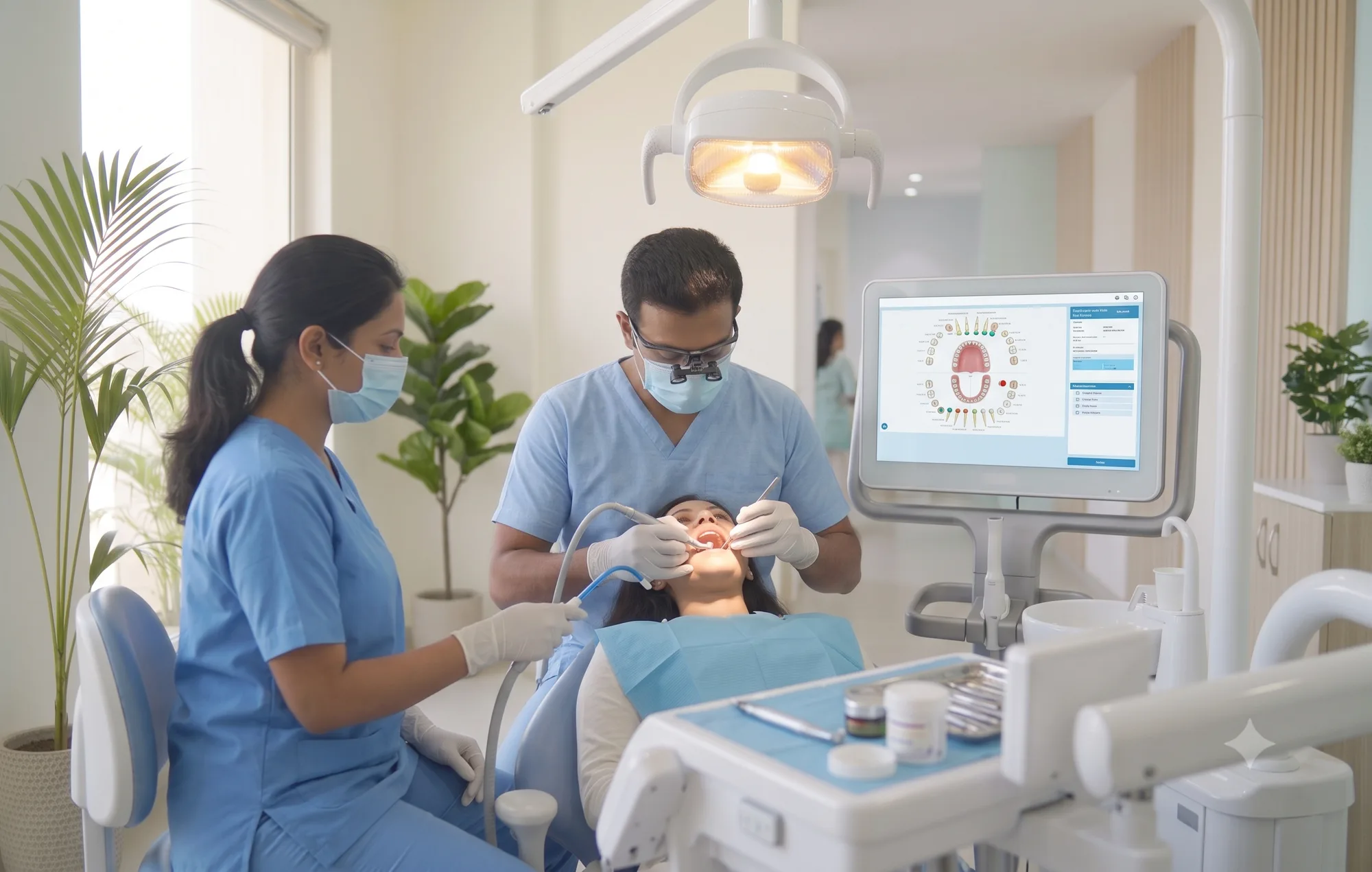
 AI-generated image
Key takeaways
- An inlay fills a cavity inside the chewing surface, an onlay also covers one or more cusps, and a crown caps the whole visible tooth.
- Inlays and onlays are made to fit in a dental laboratory and keep more of your natural tooth than a crown does.
- They suit back teeth with damage too large for a strong filling, but not so extensive that the whole tooth needs covering.
- A crown is still the right choice for badly broken teeth and for most back teeth after a root canal.
When a back tooth has a large cavity, an old filling that has failed or a cusp that has cracked, the choice is not always between a filling and a crown. Inlays and onlays sit in between. They are custom-made pieces that restore the tooth while removing less healthy tooth than a crown. Here is how the three compare.
Quick answer: An inlay replaces the middle of the chewing surface, an onlay also covers one or more of the tooth's raised points (cusps), and a crown covers the whole tooth. If enough strong tooth remains, an onlay can protect it while keeping more natural structure than a crown. If the tooth is badly broken or has had a root canal, a crown is usually the safer choice.
Inlay, onlay and crown in one sentence each
- An inlay is a custom-made piece bonded into a cavity within the chewing surface, between the cusps.
- An onlay is like an inlay but extends over one or more cusps to protect weakened walls; it is sometimes called a partial crown.
- A crown is a cap that covers the entire visible part of the tooth above the gum.
How much tooth each one removes
This is the main difference. A crown needs the tooth to be reduced on all sides to make room for the cap. An inlay or onlay only replaces what is missing or weak, so more of your natural enamel is kept. That matters, because once enamel is removed it cannot grow back.
Side-by-side comparison
| Feature | Inlay | Onlay | Crown |
|---|---|---|---|
| Covers | Inside the chewing surface | The chewing surface plus one or more cusps | The whole visible tooth |
| Healthy tooth removed | Least | Moderate | Most |
| Protects weak cusps | No | Yes | Yes |
| Typical use | A medium cavity, or replacing a medium old filling | Larger damage, or a cracked or weakened cusp | A badly broken tooth, or most back teeth after a root canal |
| Usually made in | A dental laboratory | A dental laboratory | A dental laboratory |
| Usual number of visits | Two | Two | Two |
When an onlay is better than a crown
An onlay is a good option when a back tooth has lost a cusp or has a weak wall but the rest of the tooth is healthy. It protects the weak part while leaving sound enamel untouched, and its edges usually sit above the gum line, where they are easier to keep clean. Many dentists prefer this more conservative approach when the tooth allows it.
When you need a crown anyway
A crown is usually the better choice when much of the tooth is broken down, when several cusps are weak, or after a root canal on a back tooth, because a root-filled tooth becomes more brittle. Our guide to whether you need a crown after a root canal explains when one is essential, and our guide to a cracked tooth covers when a crown is used to hold a cracked tooth together.
Materials: ceramic, composite and gold
Inlays and onlays can be made from porcelain or ceramic, composite resin or gold. Tooth-coloured ceramic is the most common choice today because it looks natural and is bonded to the tooth. Gold is very durable and gentle on the opposing teeth but is chosen less often for appearance reasons. If a crown turns out to be the better option, our comparison of zirconia, PFM and E-max crowns explains the materials.
What the treatment involves
Treatment usually takes two visits. At the first, the damaged tooth or old filling is removed, the tooth is shaped, and an impression or digital scan is taken; a temporary filling protects the tooth in the meantime. A dental laboratory then makes the inlay or onlay to fit. At the second visit it is bonded in place and the bite is checked and adjusted for comfort. Our inlays and onlays page explains how we plan this treatment at our Viman Nagar clinic.
Replacing an old silver filling with an inlay or onlay
A large old amalgam filling that has cracked or is leaking can often be replaced with a tooth-coloured onlay, which also protects the weakened cusps around it. A sound old filling, however, does not need removing. Our article on replacing old silver fillings explains when it is worth it, and our guide to types of dental fillings covers smaller repairs.
Sources & further reading
American Dental Association (MouthHealthy) · FDI World Dental Federation · NHS, Dental Health · Indian Dental Association
About images: Images labelled 'AI-generated image' are illustrations created with AI tools. They do not show Prudent Dental Clinic, our team or our patients. Real photos of the clinic are captioned as such.
Inlay vs onlay vs crown: your questions answered
- Inlays and onlays
- Should you replace old silver fillings with tooth-coloured ones?
- Do you always need a crown after a root canal?
- Cracked tooth: pain on biting, and what to do
- Zirconia vs PFM vs E-max crowns: honest comparison
- Types of braces: metal, ceramic, self-ligating, aligners
- What is an OPG X-ray? Panoramic dental X-ray explained
- Are dental X-rays safe?
- Ceramic vs metal braces: which should you choose?
Large old filling or a cracked cusp? Ask whether an onlay could save more of your tooth. Call +91 70287 22200.
Call +91 70287 22200 · Open 7 days, 9 AM–9 PM (5 PM Sun)